

A Roadmap for Incident Leadership Development
Incident leadership training is often fragmented across multiple disciplines including safety, security, emergency management, crisis management, business continuity, and risk management.
While each discipline provides valuable knowledge, there is often no clear development path that helps managers understand what to learn, when to learn it, or how those skills connect together during a real incident. The Incident Leadership System was developed to organize these disciplines into a practical roadmap for incident leadership development. The goal was not to create another training program.
The goal was to create a practical roadmap that helps managers understand how incident leadership skills are developed over time.
The Four Phases
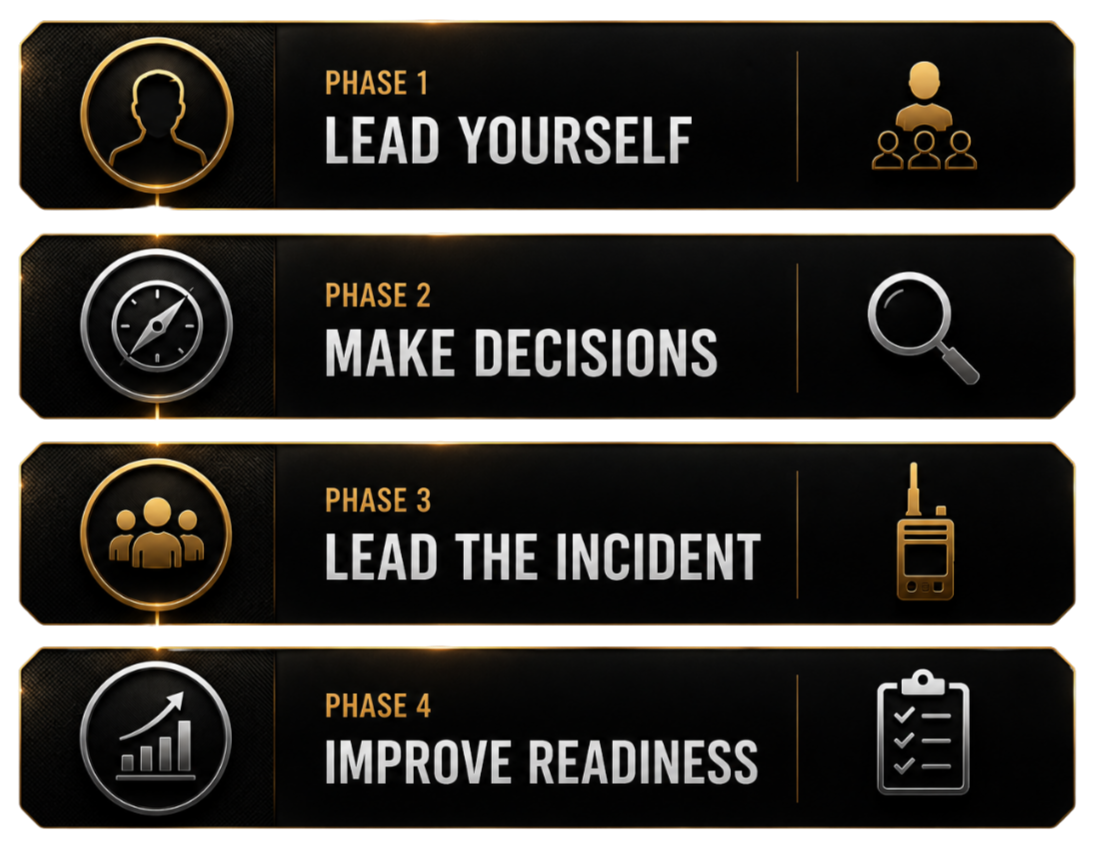
The Incident Leadership System organizes incident leadership development into four progressive phases. Each phase builds upon the one before it, creating a practical pathway for developing incident leadership capability over time.
-
The ability to remain calm, think clearly, communicate effectively, and maintain perspective becomes the foundation upon which all other incident leadership skills are built.
Key Development Areas
Leadership Under Pressure
Understanding how pressure influences communication, decision-making, and leadership effectiveness.
Cognitive Overload
Recognizing the effects of information overload, competing priorities, and rapidly changing conditions.
Situational Awareness
Maintaining awareness of what is happening, what is changing, and what requires attention.
The CALM Framework
Developing practical techniques for maintaining composure and focus during uncertain situations.
-
The ability to assess information, identify priorities, and make informed decisions under uncertainty is a critical incident leadership skill.
Key Development Areas
Situational Assessment
Understanding what is known, what is unknown, and what information is needed to support decision-making.
Information Verification
Separating facts from assumptions, rumors, and incomplete reports.
Decision-Making Under Uncertainty
Developing confidence to make informed decisions before all answers are available.
Escalation & Notification
Recognizing when situations require additional resources, leadership involvement, or external support.
The UTRF Framework
A practical decision-making framework designed to help leaders navigate ambiguous and evolving situations.
-
During unexpected incidents, people often look for direction, priorities, and reassurance. Without a clear leadership structure, information becomes fragmented, responsibilities become unclear, and response efforts can quickly become disorganized.
This phase focuses on helping leaders establish order during uncertainty.
Key Development Areas
Communication
Creating clear information flow between leaders, employees, stakeholders, and external partners.
Accountability
Knowing who is involved, who has been accounted for, and who is responsible for critical tasks.
Coordination
Organizing people, resources, and activities toward a common objective.
Incident Leadership Roles
Understanding how responsibilities can be assigned and expanded as incidents grow in complexity.
Incident Command Concepts
Applying practical command and control principles that help organizations create structure before first responders arrive.
-
Strong incident leaders are built through experience. Strong organizations are built through preparation.
Incident leadership development does not end when an incident concludes.
Organizations that consistently improve their readiness are those that take time to evaluate performance, identify gaps, practice together, and strengthen their capabilities before the next incident occurs.
This phase focuses on turning lessons into improvements and preparedness into organizational confidence.
Key Development Areas
Readiness Assessments
Evaluating current capabilities, identifying strengths, and uncovering opportunities for improvement.
Tabletop Exercises
Providing leaders with opportunities to practice decision-making, communication, and coordination in a controlled environment.
Lessons Learned
Capturing observations, successes, challenges, and opportunities following exercises and real-world incidents.
Program Development
Building systems, processes, and leadership structures that support long-term readiness.
Continuous Improvement
Creating a cycle of assessment, practice, evaluation, and refinement over time.
Each Phase of your journey
Why The Order Matters
Attempting to lead others before learning to manage yourself often creates confusion. Attempting to coordinate a response before making decisions creates hesitation. Attempting to improve organizational readiness without understanding incident leadership often results in plans that look good on paper but are difficult to execute under pressure. The Incident Leadership System is designed to build each capability in a logical sequence. Each phase strengthens the next.
The Goal
The objective is not to create emergency management experts.
The objective is to help managers develop practical incident leadership capability that can be applied across a wide range of unexpected incidents.
Whether the incident involves Severe Weather, Fire, Medical Emergencies, Security Concerns, Operational Disruptions, Ambiguous Threats.
The leadership principles remain remarkably consistent. The Incident Leadership System provides a practical roadmap for developing those principles over time.
Applying The System
The Incident Leadership System provides the roadmap.
Workshops, exercises, assessments, and consulting engagements provide practical opportunities to develop and apply each phase of the system.
Explore the Workshops section of the website to learn more about the learning experiences that support each phase of the system.